Thursday, March 10, 2011
Counselling and play bring life back to traumatized children in Balochistan
By A. Sami Malik
Balochistan, Pakistan, 25 October 2010 – Syeda Khatoon, a grandmother in her fifties, faces a double ordeal: recovering from the flood-related death of her son, Syed Ghulam, and caring for her six grandchildren in the Mangoli camp. Her daughter-in-law died in 2008 while giving birth to her sixth child, leaving Ms. Khatoon to raise her grandchildren. After the massive flooding that began in July 2010, she managed to flee from her native village near Shikarpur, one of the worst flood-affected cities in Sindh Province, across into Dera Murad Jamali, in Balochistan.
“We had to leave our home overnight,” Ms. Khatoon said. “We spent two nights on a roadside as I begged people for a ride to a safer location. No one wanted to carry us as they were all in a hurry trying to save their own lives. We were penniless and I had to sell my granddaughter’s earrings to raise money for transportation to this camp.”
Ms. Khatoon eventually reached the Mangoli camp in Balochistan’s Nasirabad district. She felt extremely vulnerable as the sole head of a family. Many of the 418 families in Mangoli camp were headed by women, because men either perished in the floods or moved to major cities in search of work. Most of the families in the camp had been there for more than two months. Those managing the camp encouraged them to move back to their places of origin, but many villages were still under water. And once they returned home, families faced further hardship, because many houses and belongings were washed away by the floods.
With no source of income, Ms. Khatoon is completely dependent on the camp’s services. She is unsure about the future and extremely worried about the well-being of her orphaned grandchildren.
Balochistan is one of the five provinces in Pakistan. It is the largest but has a low population density. According to Balochistan’s Provincial Disaster Management Authority, 11 districts in the province were affected by the floods - impacting the lives of an estimated 700,000 people, nearly 6 per cent of the total flood-affected population in Pakistan. Schools, health facilities, food and livestock, roads and bridges and other infrastructure were partially or completely damaged.
UNICEF, with the help of its implementing NGO partner, Society for Empowering Human Resource (SEHER), established 11 child-friendly spaces in the Mangoli camp. These places are safe havens for children. Children can play and learn through playful activities and a counsellor is available to help them overcome their trauma. The child-friendly spaces in Mangoli are among the 64 fixed and 12 mobile child-friendly spaces in Balochistan. Nearly 6,000 children benefit from the services offered. Child protection committees have also been established to support these places within camps for internally displaced persons.
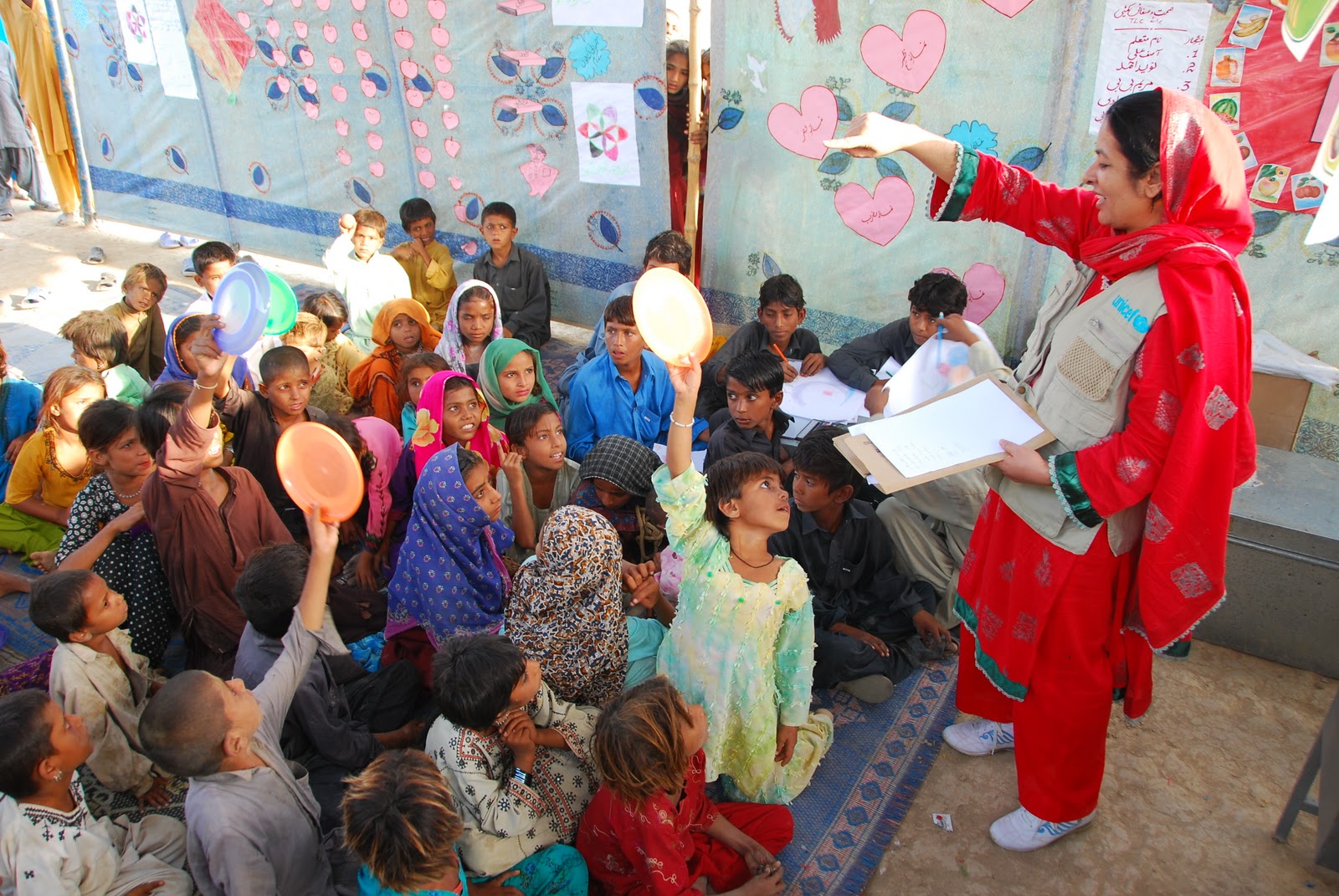
Two women-friendly spaces were also established in the camp to provide psychosocial support and privacy for breastfeeding women. More than 600 women have benefited from these this service.
“All we have in this camp is this tent,” said Syeda Khatoon. “Sometimes we don’t even get food on time. But I am happy that five of my grandchildren go to the centre [the child-friendly space]. They are learning how to read and write, and when they come back, they keep talking about it. I don’t understand any of what they talk about, but I know that they are happier than before.”
One of Ms. Khatoon’s grandchildren, Naseeba, 12, had never been to school prior to arriving in Mangoli. Exposure to the child-friendly environment and learning through playful activities has been an eye-opener for her. She shows keen interest in all activities and learning as well as the games.
“We study in this centre,” Naseeba said, “and do whatever the Baji [teacher] tells us to do – read, write or play. We then go home, have lunch and come back to the centre. I skip a rope, play football and other games. I wish that when I go back home there is a centre like this where I could study.”
Psychosocial support is a strong force for normalizing the lives of women and children affected by the floods. UNICEF helped SEHER hire Arifa, a qualified psychosocial counsellor who moves among the various child-friendly spaces. The children have developed a strong bond with her.
“The fear of the floods is still on their minds,” said Arifa. “By helping them to play games, giving them special attention and talking to them, we try to help them overcome that fear. We provide them counselling, as a result of which they are gradually coming out of the trauma and returning to a normal life. The smile, happiness and innocence, which should be on every child’s face, are gradually coming back to these child
Thursday, January 20, 2011
UNICEF's Continued support 6 months after the floods in Balochistan ...
By : Jawahir Habib
The flood hit areas of Balochistan still show a grim picture of devastation from the worst floods in the history of the country. According to PDMA floods affected a population of 700,000 in Balochistan province only. Martin Mogwanja, the UN Humanitarian Coordinator in the region termed the situation in Balochistan as “A tragedy within a tragedy”.
Young girls utilizing emergency latrines and hygiene products
provided by UNICEF at ShahChowki Camp Jafferabad
|
Photo credit: UNICEF/Pak2010/Sami Malik
|
Balochistan is the province with lowest literacy rates and poorest health indicators in the country. 69% of households in Balochistan have no improved toilet facility at all. About 66% households in Balochistan don’t have access to water in their premises.
In emergencies such as the 2010 Pakistan floods UNICEF is committed to ensure that the flood affected children and woman have access to sufficient water of appropriate quality and quantity for drinking, cooking and maintaining personal hygiene. UNICEF Balochistan continues to provide clean drinking water to 340, 000 people in two most flood affected districts Naseerabad and Jafferabad on daily basis through 76 water tankers after 6 months of floods hitting these districts of Balochistan
UNICEF is working on recovery and currently has installed 17 drinking water treatment plants in Naseerabad and Jafferabad providing clean drinking water to around 84,000 men women and children.
A Boy fetching water from water filters
established
by UNICEF at ShahChowki Camp Jafferabad..
Photo credit: UNICEF/Pak2010/Sami Malik
|
UNICEF Balochistan has been working in the five most affected districts Naseerabad Jafferabad, Sibi, Kohlu and Barkhan to provide access to toilets and washing facilities that are culturally appropriate ,secure ,sanitary and gender appropriate. More than two thousand five hundred emergency latrines and two thousand two hundred washing places have been constructed in the five most affected districts benefiting a population of hundred thousand floods affected man women and children.
To increase awareness about child illness especially water borne diseases as diarrhoea UNICEF Balochistan has conducted 1,985 Hygiene promotion sessions in five most affected districts (Kohlu, Barkhan, Sibi, Naseerabad and Jaffarabad) provide health and hygiene related information to 37,715 men, women and children.The situation in the flood affected districts has been improving however the districts face major challenges regarding water sanitation and Hygiene. UNICEF along with its partners is working in these areas to ensure that Girls, boys and women have protected and reliable access to sufficient, safe water and sanitation and improved hygiene facilities.
Friday, December 10, 2010
Tuesday, November 16, 2010
Temporary learning centres offer new opportunities for children in Pakistan's flood-relief camps
By Sami Malik
BALOCHISTAN, Pakistan, 15 November 2010 – Sitting in her family’s tent, Reshma, 8, proudly shows her mother a textbook she received from the temporary learning centre – or TLC – here in a relief camp located at the Jaffarabad Flour Mill.
| VIDEO: 26 October 2010 - UNICEF correspondent Anja Baron reports on temporary learning centres operating in the flood-relief camps of Balochistan Province, Pakistan. Watch in RealPlayer |
Reshma had no exposure to formal education prior to her arrival at this camp for people affected by recent flooding in Pakistan. Now, she is one of the regular students at the TLC, established by the Balochistan Boy Scouts Association (BBSA) with support from UNICEF.
Before the floods, Reshma’s parents lived in Mala Bagan Baba village, near the city of Jhatpat in Jaffarabad district. When the floodwaters came, they had to pack up their five children and flee. Fortunately, the Jaffarabad Flour Mill camp had been set up only 3 km west of their village. Here, they were registered and allocated a tent.
Window of opportunity for education
In the midst of the crisis, Reshma’s parents scarcely could have imagined that this hardship would open a window of opportunity for their children – an opportunity for education. “Our house, village and all belongings have been lost in the floods,” says her mother. “We have come to this camp and our children are happily studying here. The rest we can withstand.”
| © UNICEF Pakistan/2010/Sami |
| A teacher and students inside a temporary learning centre at the Jaffarabad Flour Mill relief camp in Pakistan's flood-affected Balochistan Province. |
The Jaffarabad Flour Mill camp is situated between the highway and the railway line that link Balochistan Province to the rest of the country. Almost 7,000 displaced people, most of them children and women, reside in the camp.
UNICEF started supporting the affected population soon after the camp was commissioned in early August. Through its non-governmental partners, UNICEF is providing safe drinking water and sanitation facilities. It has also established child-friendly spaces for recreation and learning activities, and the TLCs for providing basic education. So far, 18 TLCs have been established in the camp, benefiting over 1,300 girls and boys.
Overall, UNICEF has supported a total of about 140 TLCs in the three flood-affected districts of Jaffarabad, Nasirabad and Sibi – and in Quetta, which has not been hit by floods but where some of the flood-affected population is residing in camps. At present, nearly 7,000 boys and girls are enrolled in the TLCs of Balochistan. UNICEF is providing them with ‘School-in-a-Box’ kits, emergency education and recreation kits, water coolers and school furniture.
Students eager to learn
Nadia is one of the teachers hired by the BBSA to work at a camp learning centre. Her own plans to pursue further studies after matriculation were disrupted when the floods displaced her family to the Jaffarabad camp.
| © UNICEF Pakistan/2010/Sami |
| Reshma, 8, is a student at the temporary learning centre in the Jaffarabad Flour Mill flood-relief camp, Balochistan Province, Pakistan. |
“I have 103 students here. These girls are studying Urdu, English and Mathematics. They are eager to learn,” she says. “By seeing other children study, more are becoming attracted to learning for the first time in their lives. Some of them were not going to school in their native village or city, but they are studying here and with a lot of eagerness.”
UNICEF Education Specialist Sanaullah Panezai explains that the TLCs provide benefits that transcend schooling.
“Besides catering to the needs of children whose education was disrupted by the floods,” she says, “TLCs are designed to absorb diversity and uphold inclusiveness.” Ms. Panezai adds that the centres provide opportunities for learning, socializing and recreation – including opportunities for children who were earlier excluded from the education system.
You can also follow the story on unicef global site :
Wednesday, November 10, 2010
Monday, November 8, 2010
Tuesday, October 19, 2010
Protecting Children from disease
By Jawahir Habib
Children affected by the floods are at high risk of communicable diseases such as Measles and Poliomyelitis. Pakistan is one of the endemic countries for polio where virus circulation has not been interrupted and 69 cases of wild Polio virus have been confirmed to date.
“My children have never received vaccination shots “claims Abdul Salam.”The immunization centre was far away from my village and we never knew importance of vaccination “he adds getting his eight month old son vaccinated by the outreach teams in Naseerabad. More than ninety thousand children are affected by the floods in Balochistan province only. The routine immunization coverage is low in Pakistan and only about 35% of children in Balochistan are fully immunized
Displaced children are at great risk of communicable disease such of measles and polio, as Pakistan is one of the 4 endemic countries where polio virus circulation has not been interrupted and there have been 78 confirmed case of WPV in the country so far. Measles is recognized as a major killer of children in emergencies. As in emergency situations the health services infrastructure is damaged interrupting routine immunization adding to that the overcrowding in residential camps increases the risk of infections. Children of developing world are at higher risk of death from complication of measles and the death rate may be as high as 25% among displaced children who are malnourished and have poor access to healthcare facilities.
The phase one of mass immunization was planned in the 40 worst affected districts of Pakistan which included 3 districts from Balochistan and in Phase two remaining districts are to be covered. For the phase 1 of mass immunization More than 192000 under 5 were vaccinated for measles and about 218765 under 5 years old for polio in Naseerabad, Jafferabad and Sibi districts with UNICEF support. Vaccination services were provided at 72 fixed centres and 186 outreach teams were involved in the activity.
Maryium's Story....
By Jawahir Habib
Ten year old Mariyum giggled joyfully as she skipped on her skipping rope at the Child Friendly Space established by UNICEF and its partners at Al-Huda IDP camp Quetta. Mariyum along with her mother four sisters and three brothers was displaced when the worst floods in the history of Pakistan hit Jafferabad district of Balochistan .Estimated five thousand seven hundred families were affected in district Jafferabad only.
![]() |
| Mariyum with her friends |
Situations like natural disasters and emergencies leave deep psychological impact on children .The uncertainty and insecure condition in camps lead children to be emotionally traumatized. Like Mariyum many others children had to leave behind their homes and schools, in some families’ male members stayed behind to protect the home and lands making the family more vulnerable.”On our way to the camp I saw children living on roads their parents were asking for food and water, my mother cries the whole day .I left behind my friends and my home.” says the young girl
![]() |
UNICEF Balochistan along with its partner organizations has established eight child friendly spaces for IDPs in district Quetta and Sibi. Four of these child friendly spaces are established in Eastern Bypass IDP camp Quetta which hosts more than one fifty families.240 children have joined these child friendly spaces in IDP camp Quetta.
These children are provided with a safe and friendly environment to get involved in indoor games, make friends and get involved in more informal education where main focus is on Health education, literacy and numeracy and on life skills
Sunday, October 3, 2010
Thursday, September 30, 2010
Education for displaced children affected by Pakistan floods
By Sanaullah Panezai
Quetta, Balochistan, 6 September 2010 -During the past three weeks, over 400 Internally Displaced People (IDP) fleeing from floods in Balochistan and Sindh have been hosted at the Headquarters of the Balochistan Boys Scouts Association. It is estimated that half of these desperate people are children.
Children suffer the most in any emergency and restoring a sense of normalcy often helps them to cope and build resilience in any crisis. Temporary Learning Centres provide opportunities for traumatized children to process what they have experienced in a safe and protective environment. With the support of trained teachers, they experience a sense of normalcy in what are usually abnormal circumstances.
UNICEF Balochistan, with the collaboration of the local Government, has established a Temporary Learning Centre for flood affected children. To date, 150 students have enrolled and been organized into two different age-group classes : 3-5 years and 6-11years. UNICEF has provided children with a School in Box kit, containing basic learning materials - mainly note books, color pencils, contingent school bags, erasers and sharpeners - amongst other supplies. A trained team of teachers has been mobilized from Pishin, the nearest district, in order to facilitate learning and recreation activities through child friendly methodology.
Farzana
![]() |
| Nine-year-old Farzana, from Jacobabad, Sindh, draws with other children in the temporary learning centre set by UNICEF and local partners. ©UNICEF/Pakistan/Panezai |
Nine-year-old Farzana is from Jacobabad, in the Sindh province, and during the flood she was residing with her parents in Rojhan Jamali, in Balcohistan. Before the floods she was a student in the 2nd class at Government Girls Primary school, Goth Ahmed Mia Somoro, Jacobabad, Sindh - her place of origin. She loves drawing and was excited to be able to restart this activity by using the supplies provided by UNICEF through the School in a Box kit. She was drawing pictures of flowers. When the floods came she was at home and her family members were asked to immediately quit the village.
Farzana has three brothers and four sisters. Her father is a laborer working in Rojhan Jamal, Balochistan. The floods hit Rojhan Jamali suddenly and her family and other villagers fled. Farzana's family couldn’t go back to her home town, which was already heavily flooded, and the roads from Balochistan to Sindh were already washed away. The only alternative was for her family to move towards Quetta, Balochistan. The Boy Scouts Association, one of UNICEF’s partners in the area, have mobilized their volunteers and accommodated around 400 IDPs.
While she is pleased to be safe, life under a tarpaulin is not easy. “There are mosquitoes and we are all cramped together," she says quietly, eyes cast down towards the ground. “I was scared,” she whispers. “Really scared.”
Like others in the UNICEF supported Temporary Learning Centre, Farzana is desperate to return home. “The first thing I want to do is see my best friends and my school teachers. I can’t wait to go home.”
Abdul Qadir Ali
![]() |
| Eight-year-old Abdul Ali, from Jafarabad, is now benefiting from the UNICEF-supported temporary learning centre, in Quetta, Balochistan. ©UNICEF/Pakistan/Panezai |
Eight-year-old student Abdul Qadir Ali is from Jafarabad, Balochistan. In the confusion and chaos that ensued when he ran with his sisters and brothers to escape the floods, he stumbled and grasped a live electrical wire, which caused him to suffer an electric shock and burn his right hand.
For seven days his wound remained untreated and infected, causing a very intense pain. Fortunately, the Balochistan Boy Scouts Association arranged for first-aid services to treat Abdul and now the throbbing pain that kept him awake at night has smoothen down. With a little smile he holds up his UNICEF school bag, filled with pencils, notebooks, erasers and a ruler. “I am going to have to learn to write with my left hand now, “ he says. “I am going to be a doctor one day, so if this happens to another boy, I can fix him quickly,” Abdul adds.
Education for displaced children affected by Pakistan floods
Saturday, September 25, 2010
UNICEF ...Saving lives.. Providing Clean water to drink
By Jawahir Habib
During the emergencies one of the great challenges is maintaining hygiene in the camps and open locations. UNICEF focuses its efforts on providing children and women access to toilet and wash facilities that are appropriate culturally and for both genders. 749 emergency latrines and 556 washing places constructed in five districts (Barkhan, Kohlu, Sibi, Naseerabad and Jaffarabad) through UNICEF Balochistan Support, benefiting around 29,960 people. 750 emergency latrines and 400 washing places constructed by WASH cluster partners in three districts (Sibi, Naseerabad and Jaffarabad) benefiting around 30,000 people. More than 1,190 hygiene sessions have been conducted and 13,000 hygiene kits have been distributed. These hygiene kits have benefited 91,000 people in the flood affected districts.
UNICEF is committed to provide children and women access to sufficient water of appropriate quantity and quality for drinking, cooking and maintaining personal hygiene during the emergencies. About 700,000 people in Balochistan have been affected by floods and more then seventy five thousand households have been damaged by the recent floods in Balochistan. During the natural disasters like floods the access to clean water and hygiene is interrupted making the population more prone to water borne diseases.
UNICEF Balochistan is providing clean drinking water to estimated 251,000 people, as of today through 69 water tankers in the five most affected districts (Barkhan, Kohlu, Sibi, Naseerabad and Jaffarabad) with the help of local NGOs. To further facilitate the users Along with that 15,500 jerry canes and 7,000 plastic buckets distributed in three districts (Sibi, Jaffarabad and Naseerabad.
| Two girls living in IDP Camp Quetta in front of UNICEF Emergency Latrines |
Friday, September 24, 2010
Vulnerability Analysis and Mapping (VAM): understanding and mapping Food Insecurity
WFP’s VAM unit has released the Initial Vulnerability Assessment (IVA) for the 12 severely affected districts of the province. The study was conducted from 30 August to 3 September 2010. According to IVA, the floods have damaged 85,076 households affecting 595,532 men, women and children in 12 districts of Balochistan. The results from this assessment complement’s the estimates provided by the provincial government.The World Food Program leads the fight against hunger and food insecurity on many different fronts. Sometimes the front line is an emergency such as a war or a natural disaster . To provide an appropriate humanitarian and longer-term response to complex food crises or chronic hunger triggered by poverty, WFP monitor the food security situation of populations and assess their vulnerability to events that could plunge them into the vicious circle of hunger. VAM enables WFP and its partners to draw a full picture of people at risk of hunger and malnutrition and enable to provide solutions, whether through food or other forms of assistance. |
Wednesday, September 22, 2010
Interactive Map : UNICEF flood relief activities in Pakistan
View UNICEF UK's Pakistan Flood Children's Appeal in a larger map
This map highlights UNICEF's activities in Pakistan along with success stories .The map also includes UNICEF Balochistans contribution for the province
Tuesday, September 14, 2010
The UNICEF Balochistan Staff...On field!
By Jawahir Habib
More than 600,000 IDPs have flown from Sindh province to Balochistan after the floods and torrential rains that have affected more than 20 million people in Pakistan. UNICEF has focused its relief efforts on provision of clean water and sanitation in the affected districts, along with immunization, provision of essential drugs and nutritional supplies. Apart from that UNICEF is also focusing on child protection activities and is providing education through temporary learning centres in the camps.
UNICEF Balochistan staff members raised Rupees two hundred thousand and contributed at a personal level in field relief efforts along with their daily professional responsibilities they have been performing during this time of crisis. UNICEF staff members with their provided 107 Dry Ration Packets which included flour, Sugar, Tea, Oil, Daal (grains) and High Energy Biscuits to over a hundred families in IDP Camp established by Government of Balochistan on Sariyab road Quetta. These families had been recently displaced from Jafferabad and neighbouring districts of Sindh.
![]() |
| Children at a Camp waiting for food |
![]() |
| UNICEF Staff Distributing Food |
![]() |
| Temporary shelter arrangement in the Scorching Sun |
Monday, September 13, 2010
Wednesday, September 8, 2010
Thursday, September 2, 2010
Child Friendly Spaces- A Ray of Hope for flood affected children
By Jawahir Habib
Children are the most vulnerable in the aftermaths of any natural disaster, war or conflicts. In emergencies such as floods children are at a very high risk of water-borne illnesses due to lack of clean water and sanitation. A child may get separated from his parents, may lose friends or siblings. Events such as leaving the home, their schools and living in overcrowded spaces may leave children distressed. These disasters are followed by instability which affects both children and adults and can result in psychological damage to children.
![]() |
| Child Friendly Space Quetta |
Estimated more than 8 Million children have been affected in by the floods in Pakistan. UNICEF has built structured safe sites where children meet peers, play, get involved in some informal education, relax and learn skills to deal with the risk they are face. These spaces aim on promoting sense of safety in the children, keeping the children away from dangerous places and protecting the children from exploitation or abuse.
Unicef Balochistan along with its partner organizations has established eight child friendly spaces for IDPs in district Quetta and Sibi. Four of these child friendly spaces are established in Eastern Bypass IDP camp Quetta which hosts more than one fifty families.240 children have joined these child friendly spaces in IDP camp Quetta. These children are provided with a safe and friendly environment to get involved in indoor games, make friends and get involved in more informal education where main focus is on Health education, literacy and numeracy and on life skills.
These child friendly spaces are accessible to both genders, different age groups of children are involved in different activities. Based on the cultural norms boys and girls are provided with separate child friendly spaces. The volunteers working in these child friendly spaces are from the host community and are trained in providing psychosocial support to the children.
Four of these child friendly spaces are established in Sibi mela camp. About 300 children are provided psychosocial support in the CFS, given an opportunity to express and voice their feelings and provided with a sense of safety.
Most of us would worry about what a child may become tomorrow, yet some forget that he is someone today...We at UNICEF keep that in mind while planning for Children affected by emergencies and Child Friendly Spaces established by Child protection UNICEF are an example .Let us join hands and unite for Children of Balochistan affected by the floods.
Subscribe to:
Posts (Atom)


